
Skye Mastering - The Whole Story
I started cutting in 1969, mastering as it is now called. From my first day I learnt to cut vinyl as CD didn't exist. I now master for vinyl, CD, streaming etc.
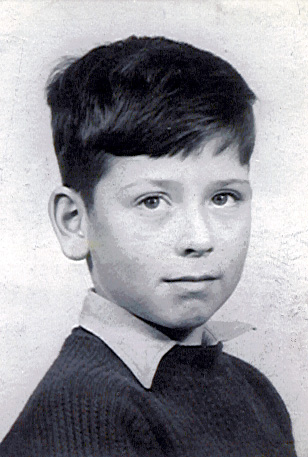
I was born on May 20th 1952, the town was Walthamstow, north east London, where I spent the first 27 years of my life. I now live in Thailand, a beautiful place to be. My parents had a radiogram that only played 78 rpm records, and there were one or two discs I used play over and over, 'Music, Music, Music' was one of them. In 1964 my father bought me a classic red and cream 'Dansette' record player, shortly followed by a reel to reel tape recorder - I could have my own records at last! I've since bought myself another Dansette to remind me of its classic sound.
The first record I bought was 'I Only Want To Be With You' by Dusty Springfield. The collection grew slowly at first as I was still at school and singles were a week's pocket money! - albums were a special treat bought for me if I was a good boy! The local Granada cinema was one of the venues for the touring pop shows of the time. There would be several bands playing the same evening, so I got to see virtually everyone who came to Walthamstow, The Beatles, The Who, Dusty, Manfred Mann, and many more. I also frequented the Seven Sisters Club in Tottenham to see The Small Faces who always put on a great show.
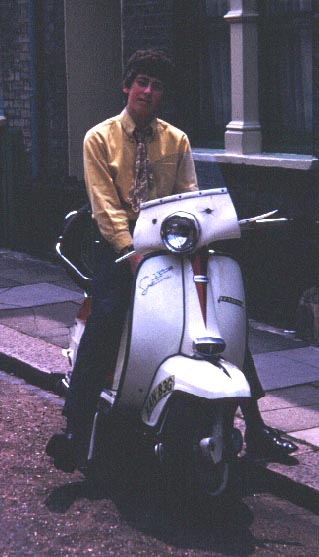
I left school in 1967 and spent two years Silk Screen printing - a job I enjoyed very much. I actually printed some of the original John Lennon posters that are much sought after today - If only I'd known then! When I wasn't working, I used to spend my evenings listening to my increasing music collection, and recording songs onto my tape recorder. I soon got bored with its basic capabilities, so out came the soldering iron to attach an on/off switch for the erase head. That allowed me to record over the original recording but, with the erase head switched off, I could have the original, plus a new recording playing at the same time, this created some interesting sounds. Tape phasing was a speciality, double tracking the same record, adjusting the speed of the second pass with gentle finger pressure on the turntable or tape reel! - I later progressed to the real thing on some mastering sessions, three machines, vari-speed, sync-lock etc.
By 1969 I decided I'd rather be in music than printing, so I wrote off to the studios advertised in Yellow Pages. I received the usual 'thanks but no thanks' replies. About a month later I received a letter from IBC Studios asking if I would be interested in becoming a cutting engineer. I had just read a book called 'Disc Recording & Reproduction', so I had an understanding of what the job was all about, and it interested me to know how the groove in that piece of revolving plastic was made. After the interview, I asked if I could see the cutting room, so the studio manager Mike Claydon, took me down to have a peek - it was the very same room pictured in the book I'd just read, amazing! I think you could call that fate - I got the job and never looked back. Brian Carroll was the cutting engineer at IBC Studios when I started, a great character I will always remember for his large 'kipper' ties and great sense of humour. Brian cut 'Hey Joe' with Jimi Hendrix actually there at the time! What a moment in history. Brian took me under his wing, taught me how cut records and use the fairly basic equipment cutting rooms had in those days. Today we have a level of sophistication we could have only dreamed of in 1969.
IBC was one of the best studio I
could have started my mastering career. Two very good studios, one large enough
for a 40 piece orchestra, two disc cutting rooms, a copy room and a well
equipped workshop. IBC, like Abbey Road, built their own consoles with a
very good clean sound. Unlike many trainees, I was never a tea-boy.
I started in the Mono cutting room which had a Lyrec disc cutting system, a Pultec equaliser, a Fairchild
limiter and one 15 inch Tannoy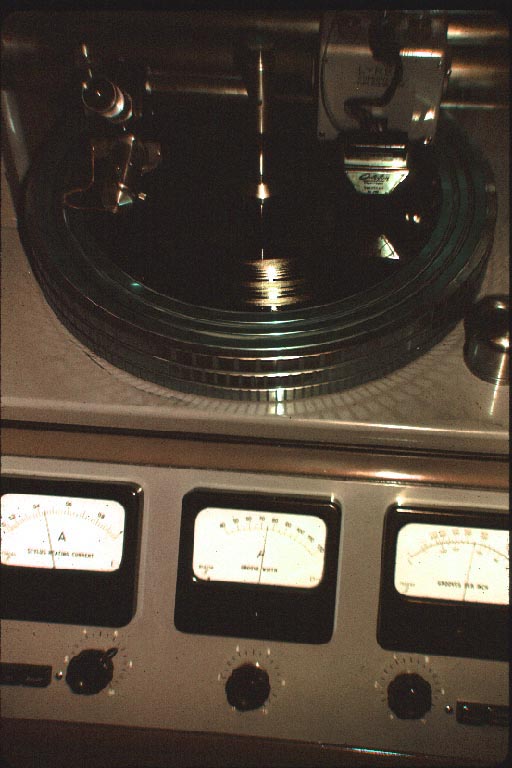 monitor in a Lockwood cabinet - thing were pretty basic in those days! Joe
Meek used to cut in the same room when he worked at
monitor in a Lockwood cabinet - thing were pretty basic in those days! Joe
Meek used to cut in the same room when he worked at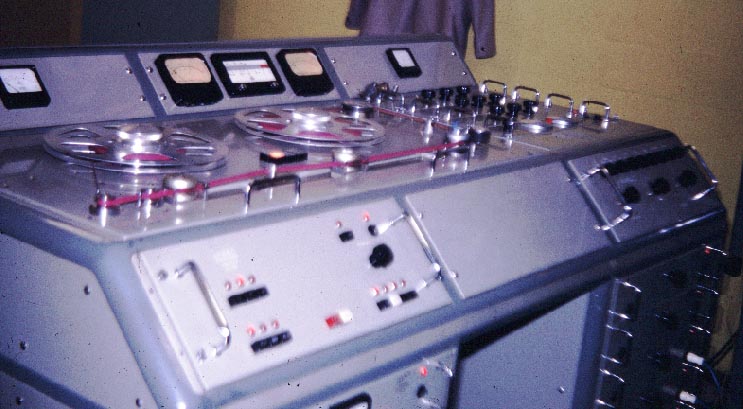 IBC back in the 50's (see pictures page). The room was then equipped with
a Neumann AM 31 Lathe and a Grampian type 'B' cutter head. When Joe
eventually set up his famed studio in Holloway Road, the now Acoustical Engineer
and Professional Studio Equipment designer Sean Davis cut many of his
productions on the same Lyrec I ended up using (see picture page). The
two pictures here show the Stereo Lyrec system, which had some very good
features, and cut many a hit record by The Who, The Bee Gees etc. One
unusual thing about the tape deck pictured, is the tape heads vary their
distance from each other depending on the combination of tape and lathe
turntable speeds. The heads moved on a track via an electric motor and
nylon cord. Micro switches were set at different places along the
track to position the heads, but sometimes they would fail to operate, so the
motor kept winding until the cord snapped catapulting the heads to the other end
of the deck! - a sight to be seen!
IBC back in the 50's (see pictures page). The room was then equipped with
a Neumann AM 31 Lathe and a Grampian type 'B' cutter head. When Joe
eventually set up his famed studio in Holloway Road, the now Acoustical Engineer
and Professional Studio Equipment designer Sean Davis cut many of his
productions on the same Lyrec I ended up using (see picture page). The
two pictures here show the Stereo Lyrec system, which had some very good
features, and cut many a hit record by The Who, The Bee Gees etc. One
unusual thing about the tape deck pictured, is the tape heads vary their
distance from each other depending on the combination of tape and lathe
turntable speeds. The heads moved on a track via an electric motor and
nylon cord. Micro switches were set at different places along the
track to position the heads, but sometimes they would fail to operate, so the
motor kept winding until the cord snapped catapulting the heads to the other end
of the deck! - a sight to be seen!
Although never trained as a
recording engineer, I did spend time in the control room learning how it was
done, and soon picked up the basic knowledge.
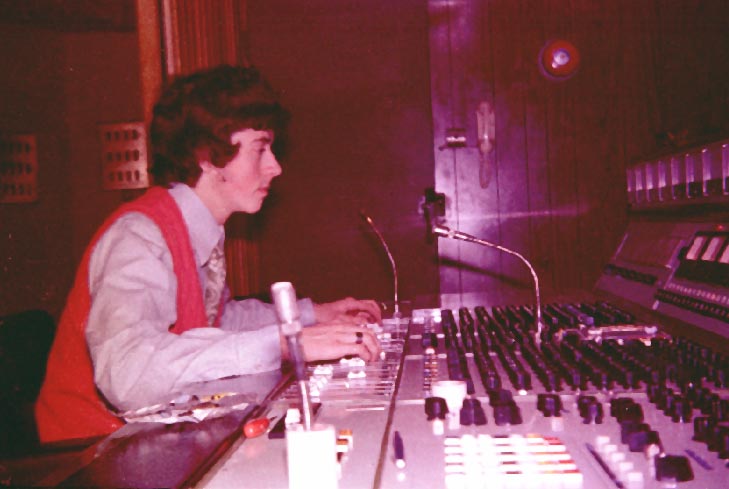 If
I wasn't busy, and could get into one of the control rooms, I would get a
multi-track master from the tape library and experiment mixing my own version of
something. When I was confident enough, I recorded an album with some friends of
mine. I also recorded another album with my
cousin Paul Stafford, a budding folk artiste from Liverpool. I recorded
these at weekends when the studios were vacant. I even got asked by
Steve Winwood if I'd like to record some demos with him, but I didn't think I
knew enough at the time, so declined the offer! I enjoyed recording,
mixing and production very much, but mastering is what's inside of me and gives
me a buzz, so that's
where I've stayed. Over 40 years later, I still love mastering, and as busy as
ever.
If
I wasn't busy, and could get into one of the control rooms, I would get a
multi-track master from the tape library and experiment mixing my own version of
something. When I was confident enough, I recorded an album with some friends of
mine. I also recorded another album with my
cousin Paul Stafford, a budding folk artiste from Liverpool. I recorded
these at weekends when the studios were vacant. I even got asked by
Steve Winwood if I'd like to record some demos with him, but I didn't think I
knew enough at the time, so declined the offer! I enjoyed recording,
mixing and production very much, but mastering is what's inside of me and gives
me a buzz, so that's
where I've stayed. Over 40 years later, I still love mastering, and as busy as
ever.
Did you ever look at the run-out area of a record? (the section between the end of the music, and the label). Did you ever see "Bilbo" and the odd little message scratched in there? Well, that's me. Around 1970 it became a trend to mark one's work with a nick name. I was reading "Lord Of The Rings" at the time, and Bilbo was the name I chose. It's a shame you can't do it with CD, but that's modern technology for you!
Until the late sixties, disc cutting in Britain was generally regarded as part of the manufacturing process. Recordings were normally transferred to the lacquer master without any major changes. America had a more studio-like approach to cutting, rooms were better equipped to alter the sound of the mix, and the American Westrex cutting system was popular, giving a very distinctive sound to a cut. It was very difficult to match some of the adjustments made to those recordings, with the equipment we had in Europe, because we generally used Neumann and Ortofon cutter heads, which had a different sound. By 1971 I remember receiving fully equalised cutting tapes from "Sterling Sound" in New York. This was a blessing and a very simple addition to a cutting room. A tape machine is connected to the output of the cutting system, recording all the changes made in the transfer to lacquer, eq's, compression, levels, fades etc. If you then need to make further lacquers, you could cut from the eq'd tape, giving a near identical transfer. The only thing it didn't generally reproduce, was the sound of the cutting head itself. The Westrex head was in a class of it's own for those hot U.S. 45's. Within a year most rooms made equalised copies, some of which are still being used today. Unfortunately, this where a lot of bad sounding reissued CD's have come from. Some of the equalisation, used for vinyl, isn't necessary for CD, so it is better to back to the original master tapes, and start again.
As I've said, some of the things you have to do for vinyl transfers are not required for CD, and can sound pretty awful. Getting back to the original master mix is the ideal situation, but this is not always possible, and on the odd occasion, not wise. Without the original cutting notes, or reference disc to match it to, it's easy to re-master something with the wrong speed, wrong fade, wrong gaps between tracks, and sometimes even master the wrong mix! Some tape boxes have little if any information as to the correct mix to use. Some of my work is re-mastering, and I'm frequently sent original master tapes from as far back as the early 1950's. You have to be very, very careful handling these tapes. My Studer A820 has a very good transport system, and I can vary my fast wind speed to be very gentle when required. Even then many edits tend to fall apart because the glue has dried out over the years. I may only want one track on a reel, but have to remake many edits before I even get to it! You must then make sure the tape is playing back properly. Some tapes have no line-up tones, so you have to manually line up the machine to cope with the master you're playing - not always easy, especially when working with tapes from the 1970's onwards. Dolby noise reduction was, and still is used, but without the correct tones, you have problems. Also, in the early days of Dolby, some machines were not lined up correctly, so even if you have tones, it still might play back incorrectly! Don't trust anything until you know it's right... This is where years of experience comes in very useful. Much the knowledge of handling analogue tape, and achieving the best results is something you absorb - if you're that type of person; I am. Some of these things cannot be written down, you just know when it's right.
One of the dangers of mastering from older analogue tapes is they can start shedding oxide all over the heads and guides, causing a loss of high frequencies, and speed fluctuation. Never try to use them in that condition, you will damage a precious master tape. That oxide is the recorded sound, so you need to keep it on the tape. Certain brands and age of analogue tape are prone to this problem, and I can normally tell before putting them on my tape machine. These tapes need to baked at a specified temperature, to help put them in a usable condition. I bake the master tapes here the day before I use them - mastered fresh from the oven!
I mastered many albums and singles in my days at IBC. My first attended cut (where the artist or producer come along to give advice on the sound they want) was Robin Gibb of the Bee Gees. A great start after my initial training. I also worked with Pete Townshend, cutting demos of the Lifehouse project that eventually became 'Who's Next'. I had the pleasure of working with Marc Bolan and his producer Tony Visconti mastering the T-Rex single 'Hot Love'. Coincidently, Marc made his first professionally recorded demo at IBC in August 1964. I also mastered Status Quo, Neil Sedaka, Malcolm and Alwyn, Thunderclap Newman, Bee Gees, Jimi Hendrix, Led Zeppelin and many others while at IBC, a truly wonderful studio to have been part of.
IBC refurbished the stereo cutting
room in early 1973. A modern, acoustically treated room with the latest
Neumann VMS 70 cutting lathe,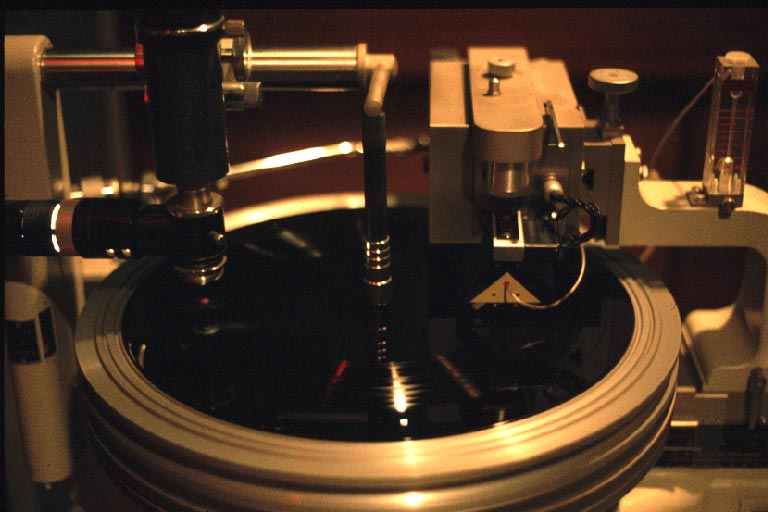 Ortofon cutting cutting head and amps, plus a custom made console with a variety
of equipment. The room soon became one of the best in London, and many
hits flowed from that turntable. The strange thing is, that lathe eventually
found a new home at Porky's Mastering, where I later worked in the early 90's -
a small world! After four years at IBC, I was well on the road learning
the art of mastering - you never stop!. I had an offer to join the team at Phonodisc in Walthamstow. I only lived down the road, so that was
very convenient and became the first of many moves in my career.
Ortofon cutting cutting head and amps, plus a custom made console with a variety
of equipment. The room soon became one of the best in London, and many
hits flowed from that turntable. The strange thing is, that lathe eventually
found a new home at Porky's Mastering, where I later worked in the early 90's -
a small world! After four years at IBC, I was well on the road learning
the art of mastering - you never stop!. I had an offer to join the team at Phonodisc in Walthamstow. I only lived down the road, so that was
very convenient and became the first of many moves in my career.
Phonodisc was completely different to IBC, it was the British pressing plant for Polydor, Mercury and all their associated labels. They had everything there except the recording studios, which were based in central London. They had a pressing plant, galvanic area (for making the stampers), label and sleeve printing, technical workshops, and a lab for scientifically testing materials being used in production, paper, paint etc. There were two cutting rooms, a cassette mastering room, playback and testing rooms, master tape and white label pressings library, and many fine people.
Everything at Phonodisc was a little white-coatish, but times were changing, and soon the cutting rooms were updated to fall in line with London and New York. Things were done quite differently to what I'd been used to. I had been trained to change the cutting styli when it became worn, and re-align my mastering system. At Phonodisc, you called the workshop if the styli need changing or if anything needed attention. Every morning, we did a test cut of plain grooves which went to the lab. They made a rubber mould of the grooves, and checked the walls and the tip radius - they decided if you put a new one in. Back in those days, the microscopes on the lathes had poor magnification, and the lighting system was less than adequate, so the lab test was a lot more useful then, but I like to get the covers off the gear and see how it works. I think you can can get more out of your equipment if you know how far you can go! Always read the manual, but then learn how do it till you can't get any better - and that's never, because there's always something new round the corner if you're willing to look.
One unusual thing we did was to master Princess Anne's Wedding Album. It was in the shops the following day, so everything had to go to plan without any hitches. The BBC recorded and edited the ceremony into an LP format, then flew the tape to us by helicopter so we could cut the lacquers. One of us waited until it the metal work was made (just in case a recut was required), then the factory pressed and shipped it through the night!
Phonodisc would get a master tape and be able to do everything else on site, so I learned a lot of things the average cutting engineer wouldn't be exposed to, like making the metalwork, the pressing, printing, and why certain types of groove shape and formation can produce problems further down the production line. I enjoyed all this extra knowledge, and it's helped me create a good cut. I was missing being in the heart of the London where the studios and everything else was, so when I got a call from RCA, I said goodbye to Phonodisc, bought myself a monthly tube train pass and off I went.
RCA had two cutting rooms and a workshop in a dedicated building off Regent Street. The main label offices were nearby and the pressing plant was in Washington, Newcastle Upon Tyne. I enjoyed my time there mastering Dolly Parton, Elvis, and the great Cleo Laine, but eventually left to play drums with a band. I had to give that up too as I had a problem with my left kidney which need removing. Fortunately, the human body can survive quite normally on about a third of a kidney, so I'm fine - cough! After my short spell in hospital, I worked in 'All Star Records', a local record shop in Walthamstow. A wonderful few months selling records to the public, including some I'd previously mastered. We were known as a helpful shop, getting non-chart records and imports for local collectors. It is so difficult these days finding a shop who will take the time to go through the reference book, find the catalogue number and distributor of a requested item - it's not difficult, but most outlets can't be bothered. I think the personal touch wins in the end. With CD and downloads, the classic record shops are diminishing, so even more difficult to find a treasured recording.
After my operation, and time behind the
counter in the record shop, it took nearly a year for me to
get back into the mastering business. Finally, in late 1976, I saw an add in
'Music Week' for a position at 'The Master Room'. It was run by
George Peckham, then one of the best cutting engineers around. Being London
based mastering engineers, we were already friends, so George offered me the
job. There was
only one mastering room, so we
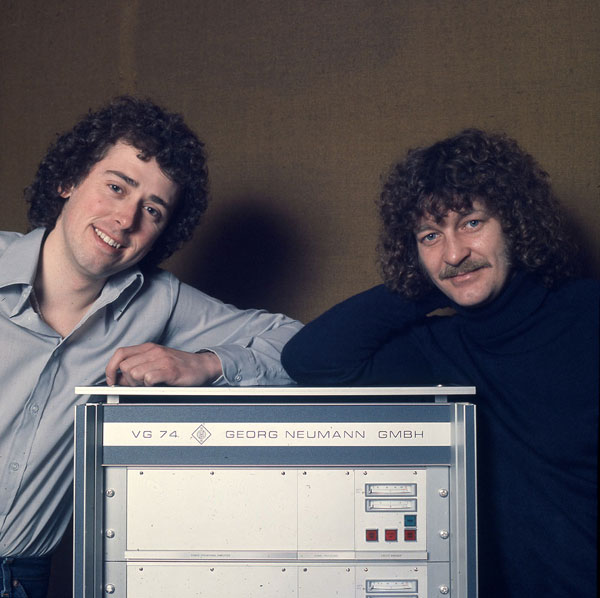 worked
'day on, day off', which is a fairly standard practice in the mastering world. It meant you could work into the night
if needed and have the next day to recover! This allows more efficient use of
the expensive equipment, plus working every other day, engineers remained fresh.
Lots of big hits passed though my hands here, and sometimes it pays to leave
things alone if they sound good, as the next few lines explain. MCA had
booked a session for me to cut reference acetates of the music for a new stage
show. I put the tapes on, carefully lined up the test tones on the tape
machine, and pressed play! I listened through to this double album's worth
of beautiful music and songs. I decided I could not improve on what David
Hamilton-Smith (the recording engineer) had given me, so I cut them just as he'd
mixed them. I sent these acetates off, and a few days later another session
was booked for me to cut the final lacquers for manufacturing. David later
said he'd sent the tapes to various mastering rooms to see what results came
back. Fortunately, he preferred mine, and was quite amused and pleased I
had cut them as per his mixes. The album was the excellent, and still
popular 'Evita'. We had more good
mastering times with the singles from the show, and later with 'Cats' etc.
Another great record I mastered a year or so earlier "as per the tape" was
"Autobahn" by Kraftwerk. Great album, great music, and a great mix for
it's time.
worked
'day on, day off', which is a fairly standard practice in the mastering world. It meant you could work into the night
if needed and have the next day to recover! This allows more efficient use of
the expensive equipment, plus working every other day, engineers remained fresh.
Lots of big hits passed though my hands here, and sometimes it pays to leave
things alone if they sound good, as the next few lines explain. MCA had
booked a session for me to cut reference acetates of the music for a new stage
show. I put the tapes on, carefully lined up the test tones on the tape
machine, and pressed play! I listened through to this double album's worth
of beautiful music and songs. I decided I could not improve on what David
Hamilton-Smith (the recording engineer) had given me, so I cut them just as he'd
mixed them. I sent these acetates off, and a few days later another session
was booked for me to cut the final lacquers for manufacturing. David later
said he'd sent the tapes to various mastering rooms to see what results came
back. Fortunately, he preferred mine, and was quite amused and pleased I
had cut them as per his mixes. The album was the excellent, and still
popular 'Evita'. We had more good
mastering times with the singles from the show, and later with 'Cats' etc.
Another great record I mastered a year or so earlier "as per the tape" was
"Autobahn" by Kraftwerk. Great album, great music, and a great mix for
it's time.
I've never been one for the hustle and bustle of a big city, so when an offer came to work at Nimbus Records on the borders of England and Wales, I packed my life into several bin liners and headed for the Forest Of Dean! - a beautiful part of our fair land.
Nimbus was a major
manufacturers of top quality classical vinyl and CD. They also developed a laser
glass mastering machine that won them awards. Back in
late 1977 when I joined the team, they were a very high quality record pressing
factory with a classical recording studio set up in a mansion just outside
Monmouth. It's set in a very beautiful part of the Wye Valley, with the
English/Welsh border running along one edge of their land. The River Wye
meanders through the grounds, and there's a lot of open space to take yourself
off to when
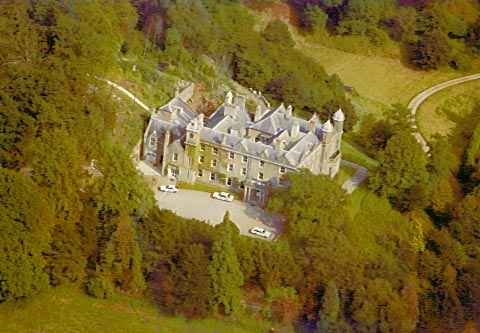 time
allowed. I stayed in the Nimbus mansion for a few weeks, then rented
a lovely place called 'Rose Cottage' at Symonds Yat East, just along
the river from Nimbus. That was great, I had the river outside the front
of the cottage, a great
little pub down the path, and the Forest of Dean all around - bliss. Nimbus
wanted a cutting engineer to take over from one of the owners who cut everything
up to when I joined the company. Nimbus were always experimenting on
ways to improve the recording, transfer, and mass production of music. A
lot of people thought them too fussy, but they explored areas others thought ok
- and always came up with a better solution. Nothing was taken for
granted, every piece of equipment, and ways of doing things were taken back to
the bare bones, just to see if an improvement could be made - total
perfectionists. I learned many things at Nimbus, I cut the master, sometimes I
helped make the metalwork for the pressing, I even pressed the records and put
them in their sleeves! - most enjoyable, and a great experience. A
few of my clients made the trip to Nimbus for the mastering and pressing, but
being so far away from London, which was the heart of the music business (not so
much these days), many just found a new place to work at, and after a while, I
started to feel a bit stranded. Nimbus was a classical record company, I
was a "pop and rock" person and didn't get on with their ways as well as I had
hoped, so I headed back to London again to a very small new company called 'Tape One,
soon to get much larger, very well respected, and a British leader of custom
mastering.
time
allowed. I stayed in the Nimbus mansion for a few weeks, then rented
a lovely place called 'Rose Cottage' at Symonds Yat East, just along
the river from Nimbus. That was great, I had the river outside the front
of the cottage, a great
little pub down the path, and the Forest of Dean all around - bliss. Nimbus
wanted a cutting engineer to take over from one of the owners who cut everything
up to when I joined the company. Nimbus were always experimenting on
ways to improve the recording, transfer, and mass production of music. A
lot of people thought them too fussy, but they explored areas others thought ok
- and always came up with a better solution. Nothing was taken for
granted, every piece of equipment, and ways of doing things were taken back to
the bare bones, just to see if an improvement could be made - total
perfectionists. I learned many things at Nimbus, I cut the master, sometimes I
helped make the metalwork for the pressing, I even pressed the records and put
them in their sleeves! - most enjoyable, and a great experience. A
few of my clients made the trip to Nimbus for the mastering and pressing, but
being so far away from London, which was the heart of the music business (not so
much these days), many just found a new place to work at, and after a while, I
started to feel a bit stranded. Nimbus was a classical record company, I
was a "pop and rock" person and didn't get on with their ways as well as I had
hoped, so I headed back to London again to a very small new company called 'Tape One,
soon to get much larger, very well respected, and a British leader of custom
mastering.
When I joined Tape One late into 1978, there was just Bill Foster, Barry Ainsworth and Dave Moore. We were in the ground floor and basement of a terraced house near Regents Park - very humble beginnings. Bill and Barry owned the company and Dave toggled between tape copying, editing and being the delivery boy! We were always busy, so it wasn't long before we moved to smart new premises off Tottenham Court Road, slowly expanding from a basement and ground floor to five floors of rooms ranging from cassette copying to disk and CD mastering. At one stage, we even had a recording studio in the basement, but that soon made way for the arrival of Britain's first completely digital Compact Disc mastering room. We ran a mobile recording facility too, which went all over the world. One great thing we did with the mobile was a direct to disc cut of the band 'Yes', live at Wembley Arena. The mobile sent a stereo audio feed to me at Tape One via BT landlines, plus we had two way radio contact. The idea was to cut a 12 inch disc of three songs live as they played! This was to be released as a charity record for the 'Save the Whale' campaign. We rehearsed for two shows, which went perfectly, but on the third and last night, the engineer didn't get a fader up in time for a guitar solo, which unfortunately ruined the performance and the direct to disc recording! - such is life.
I mastered many great records at Tape One, and have some lovely gold, silver and platinum awards for the big sellers, Madness, M, Tracey Ullman, Cacharpaya (remember them?), Eurythmics 'Sweet Dreams' and 'Touch' albums, plus many of their singles. Dave Stewart was good to work with, knew what he wanted, and very focused. Apart from 2 songs, the ''Sweet Dreams' album was only an 8 track recording, put together on a Soundcraft desk at their home studio. We added lots of eq and some nice valve EMT plate reverb to that album. We even recorded Dave walking up the stone steps around the lift shaft to edit onto the end of side two.
It's always great to hear
something you've done being played on the radio or television. Hearing one
of my cuts usually brings the session flooding back to
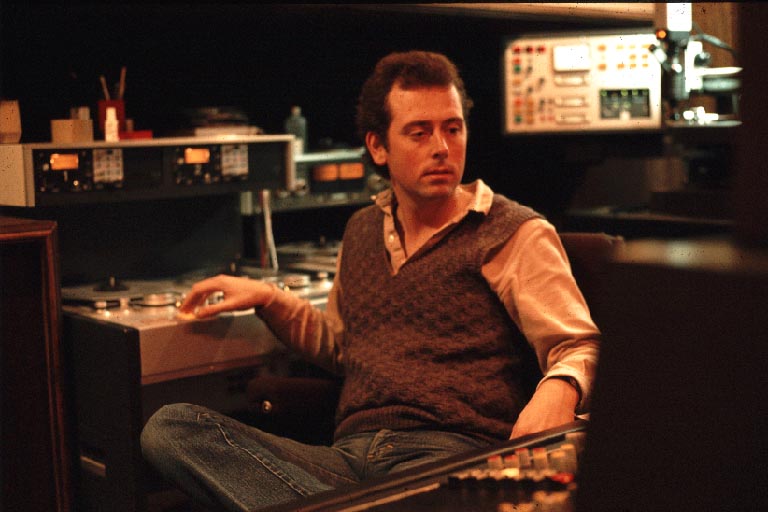 my memory. The early Human League sessions I did were always a challenge.
They had their own studio in Sheffield, and used to come down on the train for
the mastering. Most of the songs were made up of sections from several
different mixes, and the levels and sounds of each piece never matched, so I
always had this task of lots of different adjustments on a three minute track.
Today, it's not such a difficult thing to do with a computer, but back then I
had to write down all my settings, rehearse all the changes with the music, then
do it live as I cut the record! It certainly got the adrenaline pumping,
and was always worth the effort when the finished result sounded good.
my memory. The early Human League sessions I did were always a challenge.
They had their own studio in Sheffield, and used to come down on the train for
the mastering. Most of the songs were made up of sections from several
different mixes, and the levels and sounds of each piece never matched, so I
always had this task of lots of different adjustments on a three minute track.
Today, it's not such a difficult thing to do with a computer, but back then I
had to write down all my settings, rehearse all the changes with the music, then
do it live as I cut the record! It certainly got the adrenaline pumping,
and was always worth the effort when the finished result sounded good.
Pop Muzik by "M" was big hit
around the world in 1979. Robin Scott, the main man behind 'M', wrote and
produced everything. I started working with Robin back in 1976 when he had
his own small independent label. The early stuff was great, nice and raw,
but well produced considering the low
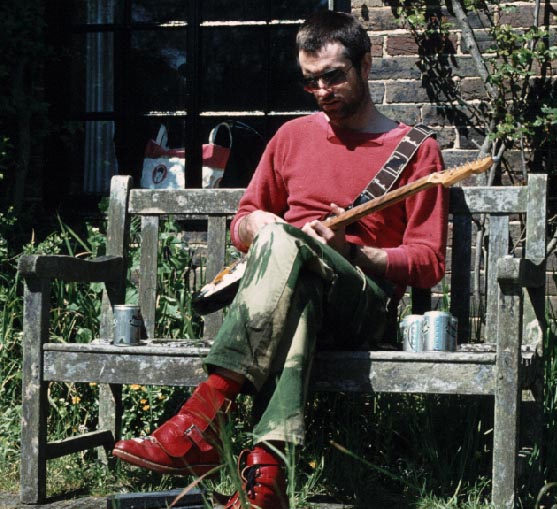 budgets
these early records were made with. When the follow up single to Pop Muzik (Moonlight & Muzak) was due for release in America, Robin said I should go
over there and supervise the mastering. Great I thought, a couple of days
in Hollywood and back - wrong! Robin was already there when I arrived, and
decided I should help out with the video for the single. We had a great
time doing that, and I'm in it too! That trip ended up being eight days in
Hollywood, and another four in New York - thanks Robin. Robin later asked
if I would like to work for him, keeping an eye on the technical side of things,
so I left Tape One and based myself in Richmond Surrey, helping out with Robin's
day to day affairs, along with Linda Witham, who had looked after him for years. The backing tracks for the second album were recorded at ICC Studios in
Eastbourne, Sussex. Robin didn't live too far from there at the time, so
it was a very pleasant and convenient location. For tax reasons, we
recorded all the vocals, overdubs and mixed the album in
Dublin, another fun packed three weeks. Philip Begley was the engineer and
a young Kevin Killen was the tape op'. Kevin is now a well respected record
producer doing lots of great stuff. I managed to croak a few
backing vocals and mixed the opening track 'Transmission'. Although we did
a lot of interesting things, I was missing my mastering room, so I happily went
back to Tape One for several more years. Another guy involved in
'Pop Muzik' was a young Tape One trainee called Nik Launay. He did some
great edits and messing about for an extended version of the song. He
is now a very successful record producer.
budgets
these early records were made with. When the follow up single to Pop Muzik (Moonlight & Muzak) was due for release in America, Robin said I should go
over there and supervise the mastering. Great I thought, a couple of days
in Hollywood and back - wrong! Robin was already there when I arrived, and
decided I should help out with the video for the single. We had a great
time doing that, and I'm in it too! That trip ended up being eight days in
Hollywood, and another four in New York - thanks Robin. Robin later asked
if I would like to work for him, keeping an eye on the technical side of things,
so I left Tape One and based myself in Richmond Surrey, helping out with Robin's
day to day affairs, along with Linda Witham, who had looked after him for years. The backing tracks for the second album were recorded at ICC Studios in
Eastbourne, Sussex. Robin didn't live too far from there at the time, so
it was a very pleasant and convenient location. For tax reasons, we
recorded all the vocals, overdubs and mixed the album in
Dublin, another fun packed three weeks. Philip Begley was the engineer and
a young Kevin Killen was the tape op'. Kevin is now a well respected record
producer doing lots of great stuff. I managed to croak a few
backing vocals and mixed the opening track 'Transmission'. Although we did
a lot of interesting things, I was missing my mastering room, so I happily went
back to Tape One for several more years. Another guy involved in
'Pop Muzik' was a young Tape One trainee called Nik Launay. He did some
great edits and messing about for an extended version of the song. He
is now a very successful record producer.
Other memorable sessions from the
Tape One days are a lot of Stiff Records singles, Tracey Ullman,
Madness, Bell Stars, etc. That was a great label to master records
for. Dave Robinson used to come over for most of the sessions, and he would
push to get every last ounce out of the mix.
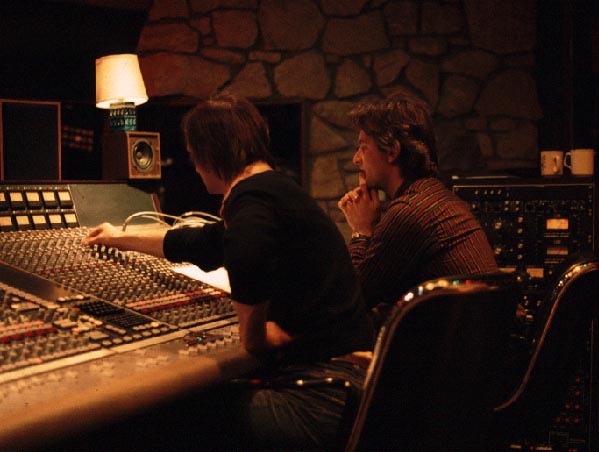 Another producer I worked with, was Mike Howlett, pictured here at Townhouse
Studios with Richard Manwaring (another IBC trained engineer). Mike used
to be the bass player in Gong many years ago, along with Steve Hillage, with
whom I've also worked on several projects. Mike produced Orchestral
Manoeuvres In The Dark (OMD), Martha & The Muffins, A Flock of Seagulls etc. We
had great times with those records, and lots of hits too! I must give a
mention to Mike Stone who had the 'Clay Records' label based in Hanley,
Stoke On Trent. He had such bands as Discharge, GBH who are Punk's legends.
Another producer I worked with, was Mike Howlett, pictured here at Townhouse
Studios with Richard Manwaring (another IBC trained engineer). Mike used
to be the bass player in Gong many years ago, along with Steve Hillage, with
whom I've also worked on several projects. Mike produced Orchestral
Manoeuvres In The Dark (OMD), Martha & The Muffins, A Flock of Seagulls etc. We
had great times with those records, and lots of hits too! I must give a
mention to Mike Stone who had the 'Clay Records' label based in Hanley,
Stoke On Trent. He had such bands as Discharge, GBH who are Punk's legends.
I spent almost twelve very happy years at Tape one, but I wanted to concentrate on CD mastering instead of vinyl. Bill Foster wanted me to continue cutting but I needed to follow what I felt inside, so I left. A blessing really as Tape One closed three years later due to a rather short sighted Soho bank manager! George Peckham who I worked with at the Master Room was in the early stages of expanding 'Porky's Mastering' to include a CD room, and the timing fitted in with me leaving Tape One. We knew it would work, and it did! We opened the CD room in October 1989 and the business flooded in. I worked my backside off for a year until we took on a young trainee, Shawn Joseph. Shawn gradually honed his craft, and is now a well respected mastering engineer with his own Optimum Mastering facility in Bristol. Being at Porky's was a different ball game for me, setting up all the digital side of the business, and running that side of things was a refreshing change to the years of cutting records.
We opened a second CD mastering room in 1993, and also started dabbling with hard disk mastering. Equipment was getting smaller but could do better and more sophisticated things. I've always been one to experiment with the gear, getting it to do things it wasn't really supposed to do, just to get a better sound or effect. The computer based mastering systems allowed a lot of user flexibility, and I liked it a lot! With equipment prices becoming more affordable, I started to feel I could set up my own facility. After twenty five years of commuting in and out of central London, and working in windowless, air-conditioned rooms, the thought of mastering at home became very appealing. So with the help of my savings and a bank loan, I was able to open my first mastering studio in March 1996 at my home in Surrey. In August 2002 I moved to the Isle of Skye, set in a beautiful quiet and peaceful location looking out to sea. In February 2022, we moved to our new home by the Nadan Beach in Thailand. I'm still mastering for many of my old and faithful clients, and some excellent new ones too. With an excellent broadband connection, your project is easily uploaded to me, and returned the same way.
I feel this mastering life was meant to be. It's something that came naturally to me. I don't really know why so many people love what I add to their music, but I'm pleased I do - Thanks to each and every one of you.